
History of RainSpike
How it started
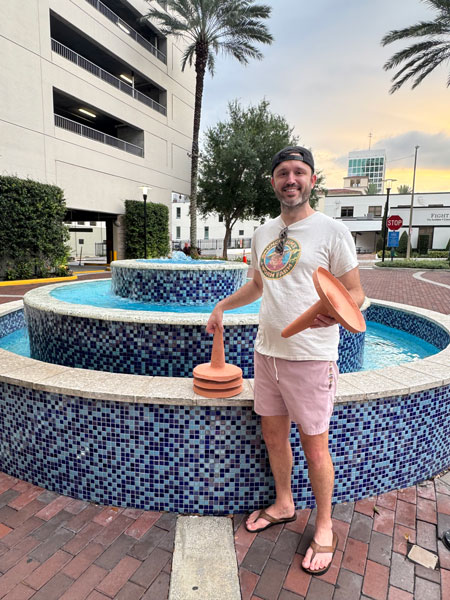
Hi, I’m Justin
I started gardening about a decade ago with a deep interest in low-tech systems that could make growing food more accessible, resilient, and less dependent on complex infrastructure. I was especially drawn to ollas—porous clay vessels used for root-zone irrigation and recognized as one of the oldest forms of passive irrigation.
But even though I loved the simplicity of traditional ollas, something felt incomplete. Most olla systems still required a person to manually refill a buried reservoir with water supplied by a hose, tap, well, or other centralized source. I kept asking myself a simple question: why can’t an olla be designed to collect and store the rain that already falls from the sky?
As I researched the problem, I realized that rainfall is abundant in many places, but much of it is lost before plants can use it. Rainwater often runs off, drains too quickly through the soil, or evaporates from exposed surfaces. At the same time, traditional ollas are not optimized to collect rainfall directly. Their openings are usually narrow, their reservoirs are sized for manual filling rather than rainfall capture, and leaving the top open can increase debris entry and evaporation.
That gap became the starting point for RainSpike.
I set out to design a rainwater-collecting olla system that combines three core functions into a single passive clay unit: collecting rainfall above the soil surface, funneling that water into an underground reservoir, and slowly releasing stored water through porous clay into the surrounding root zone. The goal was not simply to store water, but to manage the movement of water in different forms—liquid water, water vapor, gravity-driven flow, and capillary release—so that more rain enters the system and less is lost back to the air.
The resulting concept uses a broad above-ground collection surface to increase the effective catchment area, a central inlet or reservoir opening to receive water, and a tapered underground clay reservoir that stores water below the evaporation-prone surface layer. The above-ground portion can be sealed or made less porous to reduce evaporative loss, while the underground portion can remain porous enough to release water gradually into the soil. This allows different regions of the same clay body to perform different functions: collection, protection, storage, and controlled release.
As the design evolved, I focused on making RainSpike practical for real gardeners. I shaped the reservoir into a tapered spike so it could be pressed, twisted, installed, removed, and relocated more easily than a traditional buried olla. I added screw-like threads to the underground portion to help the spike enter the soil and improve contact between the clay wall and the surrounding ground. I designed the form to be stackable, reducing storage, shipping, and production inefficiencies. I also kept the system as a single clay unit to reduce parts, complexity, plastic use, and manufacturing cost.
I continued refining the water-entry side of the system as well. A mesh, grate, strainer, stone, mulch layer, pot, or other cover can be used above the inlet to reduce debris, limit direct sun exposure, and slow evaporation while still allowing rainwater to pass through. Fractal-inspired surface channels or grooves can be added to the collection dish to reduce flow resistance and direct water toward the central reservoir. The collection surface, reservoir volume, inlet size, wall thickness, clay porosity, exposed surface area, and underground depth can all be tuned to influence how quickly water is collected, stored, protected, and released.
One of the most important realizations was that RainSpike should not force every plant into the same watering condition. Every garden has different soil, rainfall, temperature, mulch, shade, and plant needs. Instead of acting like a uniform irrigation line, RainSpikes can be used in clusters, gradients, or varying densities. A gardener can place more RainSpikes where more passive water access is needed, fewer where less is needed, and relocate them as plants respond. This flexibility helps account for plants that prefer different moisture levels and avoids the rigidity of traditional buried ollas, which are harder to move once installed.
At its core, RainSpike is my attempt to modernize one of the oldest irrigation ideas in the world. It is a passive, low-tech, plastic-free clay irrigation system designed to work with rainfall, gravity, clay porosity, soil contact, root behavior, mulch, and evaporation control. Instead of depending entirely on municipal water, pumped wells, or manual refilling, RainSpike is designed to help gardens capture more of the rain they already receive and deliver that water below the soil surface, closer to plant roots, with less work and less waste.