
Create a microclimate for earthworms, fungi, and beneficial bacteria
Turn one pocket of soil into a dependable biological refuge
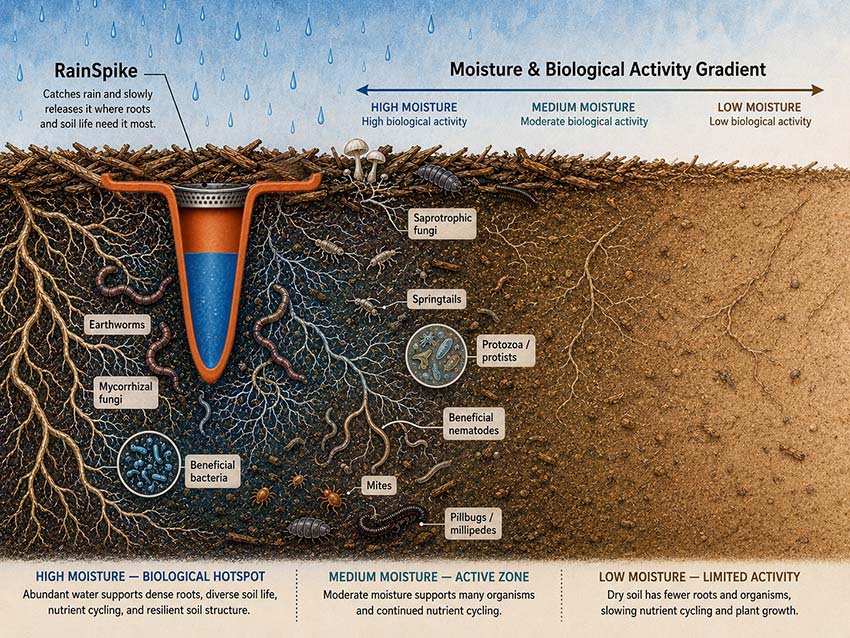
RainSpike creates a localized zone of more consistent moisture where roots, microbes, decomposers, and small soil animals can remain active between rainfall events. Rather than keeping the entire garden wet, it establishes a moisture gradient that supports a wider range of soil life.






Keep soil life active longer >
Consistent localized moisture can extend the periods when microbes, fungi, earthworms, and decomposers remain active.
Create a refuge during dry weather >
Moisture-sensitive organisms may retreat toward the RainSpike when surrounding surface soil becomes too dry.
Support the complete soil food web >
Bacteria and fungi feed protists, nematodes, springtails, and mites, which in turn support larger predators and decomposers.
Accelerate localized decomposition >
Placed beneath mulch, RainSpike can help maintain the moisture needed to break down leaves, roots, and other organic matter.
Keep nutrients cycling >
Microbes and their grazers continually transform organic material and return nutrients to forms plants can reuse.
Encourage earthworm activity >
Moist, aerated soil near organic matter provides favorable conditions for earthworms to burrow, mix residues, and redistribute nutrients.
Build biodiversity without wetting everything >
A moist center surrounded by progressively drier soil creates multiple habitats instead of imposing one uniform condition across the garden.
Create a reservoir for ecological recovery >
Organisms sheltered near the RainSpike may help recolonize surrounding soil when rain returns and conditions improve.
Learn about the beneficial organisms that RainSpikes support
Consistent, localized moisture can help beneficial soil organisms remain active longer between rainfall events.
Earthworms
- Prefer moist, oxygenated soil.
- Create burrows, improve aeration and infiltration, mix organic matter, and redistribute nutrients.

Mycorrhizal fungi
- Benefit from stable moisture around living roots.
- Extend the effective root system and improve access to phosphorus, other nutrients, and water.
Beneficial soil bacteria
- Remain more metabolically active when adequate moisture persists.
- Decompose organic matter, transform nutrients, support soil aggregation, and feed other soil organisms.
Saprotrophic fungi
- Thrive where moisture and dead plant material overlap.
- Break down tougher residues, cycle carbon, connect organic-matter patches, and help form soil aggregates.

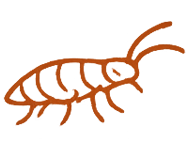
Springtails
- Many are highly sensitive to drying and favor humid soil and mulch.
- Consume fungi, bacteria, algae, and decaying matter while serving as prey for beneficial predators.
Protozoa and other protists
- Require water films to move and feed.
- Graze bacteria and release nutrients held in microbial biomass back into the soil.
Beneficial free-living nematodes
- Move through moist soil water films.
- Feed on bacteria, fungi, other nematodes, and small organisms, helping regulate populations and accelerate nutrient cycling.
- Includes bacterial feeders, fungal feeders, predators, and omnivores—not plant-parasitic nematodes.

Decomposer and fungal-feeding mites
- Benefit from humid soil containing fungi and organic debris.
- Fragment residues, graze microbes, and redistribute fungal spores and microorganisms.

Predatory mites
- Benefit indirectly where moisture sustains abundant prey.
- Consume fungus-gnat larvae, insect eggs, thrips pupae, nematodes, and other small soil animals.
Pillbugs, sowbugs, and millipedes
- Prefer damp, protected areas containing decomposing vegetation.
- Shred leaves and mulch into smaller pieces that microbes can process.
- Most beneficial near established plants; high populations may damage seedlings.
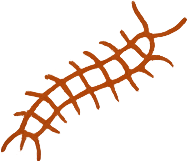
Predatory beetles, centipedes, and soil-dwelling spiders
- May gather near moist hotspots because prey is concentrated there.
- Feed on larvae, slugs, springtails, mites, nematodes, and other invertebrates.
Create a localized, aerated moisture refuge where decomposers, microbial grazers, soil engineers, and predators can remain active longer between rainfall events—not permanently saturated soil.
How does biodiversity improve with a RainSpike microclimate?
A RainSpike microclimate:
Mechanism #1
Protects soil life from “boom-and-bust” moisture cycles
A steadier habitat between rainstorms
Reduces repeated drying stress
- Many organisms slow down, move away, or become dormant as surface soil dries.
Extends productive activity
- A moist refuge may allow decomposition, grazing, and nutrient exchange to continue while nearby soil becomes inactive.
Softens abrupt environmental swings
- More consistent moisture can create a calmer biological environment than repeated soaking and drying.
Mechanism #2
Creates more habitat edges
Biodiversity often thrives where conditions overlap
Adds multiple microhabitats within a small area
- Moist soil, moderately moist soil, dry soil, mulch, roots, pore spaces, and organic residues can all occur close together.
Supports organisms with different preferences
- Moisture-loving species can remain near the RainSpike while organisms adapted to drier conditions occupy the surrounding soil.
Creates productive transition zones
- The boundary between wetter and drier soil may be especially active because roots, moisture, oxygen, and organic matter intersect there.
Mechanism #3
Provides a recovery zone after drought
A living reservoir for the wider garden
Helps populations persist through dry periods
- A localized refuge may preserve active organisms or viable populations when surrounding soil becomes inhospitable.
Supports recolonization after rain
- Mobile organisms can disperse outward once moisture returns to the rest of the bed.
Improves ecological resilience
- The garden may recover faster when beneficial organisms do not have to rebuild entirely from dormant spores, eggs, or distant populations.
Mechanism #4
Connects separate pockets of biological activity
RainSpikes can function as ecological stepping stones
Creates recurring refuge points
- Several RainSpikes may provide a network of moist habitats across a larger garden.
Supports movement through the landscape
- Soil animals, fungal growth, roots, and microorganisms may gradually move between favorable zones.
Reduces biological isolation
- Small areas of healthy soil life can become better connected rather than existing as isolated patches.
Mechanism #5
Supports more complete decomposition
Different organisms can work on organic matter in sequence
Encourages decomposer succession
- Fungi and bacteria begin breaking down residues, while mites, springtails, earthworms, and other animals fragment and redistribute them.
Processes a wider range of materials
- Soft plant tissues, woody mulch, fine roots, leaves, and microbial biomass are handled by different members of the food web.
Keeps mulch biologically connected to the soil
- Moisture beneath organic cover can help bridge the gap between dry surface material and active mineral soil below.
Mechanism #6
Builds stronger relationships between aboveground and belowground life
A healthier soil community supports the entire garden ecosystem
Turns fallen material into habitat
- Leaves, stems, mulch, and root residues become food and shelter for decomposers.
Supports prey for larger beneficial organisms
- Springtails, mites, and other small soil animals can feed beetles, spiders, centipedes, and birds.
Links plant growth to the soil food web
- Healthy roots feed microbes, microbes feed grazers, and those relationships help recycle nutrients back toward plants.
Mechanism #7
May improve biological pest balance
Support the predators, not just the prey
Provides habitat for predatory organisms
- Predatory mites, beetles, centipedes, and spiders may benefit where moisture, shelter, and prey overlap.
Supplies alternative food between pest outbreaks
- A diverse soil food web can help predators remain present even when major pests are temporarily scarce.
Encourages balance rather than sterility
- The goal is not to eliminate soil organisms, but to support enough diversity that no single group dominates unchecked.
Mechanism #8
Helps preserve functional diversity
More than one organism can perform each essential job
Creates ecological backup systems
- Multiple organisms may contribute to decomposition, nutrient release, aggregation, predation, and residue breakdown.
Reduces dependence on a single species
- When one group becomes inactive because of heat, dryness, or disturbance, another may continue part of the same function.
Makes the garden more adaptable
- Diverse communities are better positioned to respond to changing weather and seasonal conditions.
Mechanism #9
Complements other soil-building practices
RainSpike can help existing habitat improvements work longer
Pairs naturally with mulch
- Mulch supplies food and shelter, while RainSpike helps maintain moisture beneath it.
Strengthens compost-rich zones
- Organic matter provides resources for soil life; dependable moisture helps organisms process those resources.
Supports living roots and cover crops
- Roots provide carbon and habitat, creating a stronger biological hotspot around the RainSpike.
Works with—not instead of—healthy soil management
- The richest biodiversity benefits are most likely where moisture, roots, organic matter, oxygen, and minimal disturbance occur together.
Mechanism #10
Concentrates biodiversity where plants can benefit from it
Place biological activity near the root zone
Keeps nutrient processing close to plants
- Decomposition and microbial grazing near roots may shorten the distance nutrients must travel.
Encourages roots to explore an active zone
- Moisture, pore space, and biological activity can overlap in a dependable area.
Creates a focused habitat rather than watering indiscriminately
- RainSpike can support a biologically rich pocket without making the entire bed uniformly wet.